

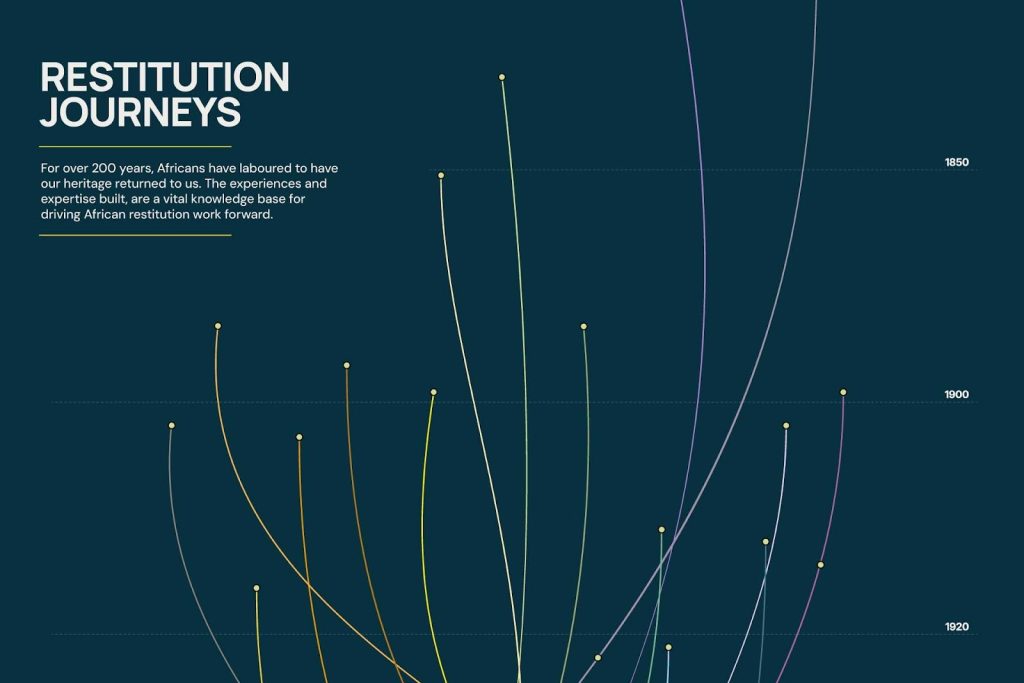
Restitution Journeys, one of the four core features of the Open Restitution Africa Data Platform, provides an overview of how restitution has taken place across Africa over more than 200 years.
This interactive visualisation brings together multiple case studies within a single timeline, allowing users to explore patterns, compare developments and follow restitution processes across different contexts.
Watch the Walkthrough
This walkthrough provides a guided introduction to the Restitution Journeys tool, explaining how to navigate the visualisation and explore different case studies.
Watch the video below:
The Restitution Journeys visualisation is structured around three main components: a timeline, colour-coded journeys and nodes representing key events.
Timeline
The timeline, located on the left-hand side of the visualisation, indicates the year and allows users to move through more than two centuries of restitution activity. As users scroll, different case studies and key moments appear, providing an overview of restitution developments across time.
Colour-coded journeys
Each coloured line represents the journey of a specific case study. These journeys trace the movement of African cultural heritage and document how restitution efforts unfold across countries and institutions. By presenting multiple journeys together, the tool allows users to understand what is happening across different restitution cases within the same time period.
Nodes
Within each journey, circular nodes highlight key moments or events. These nodes represent developments such as removals, negotiations, research, policy shifts and returns. Together, these elements provide a structured overview of how restitution unfolds across multiple contexts.
Exploring Restitution Across 200 Years
Restitution Journeys spans over 200 years of restitution activity. Early examples include the removal of the Rosetta Stone in 1801, the coercion and removal of Sara Baartman from South Africa and the exhumation and removal of Monna wa Mosarwa to France.
These cases illustrate how restitution journeys allow users to compare developments across countries and time periods.
As users move through the timeline, they can follow multiple journeys simultaneously, identify emerging patterns and highlight individual case studies for closer exploration. Users can also double click on a specific journey to focus on a single case study, and double click again to return to viewing all journeys.
For users interested in learning more, the platform dashboard provides access to additional information about each case study represented in the visualisation. This allows users to move from a high-level overview to deeper exploration.
Explore the Restitution Journeys tool:
https://dataplatform.openrestitution.africa/
Watch the walkthrough: